Record
Records are the most primitive unit of data in the Atmosphere.
A Record is plainly put, simply, a JSON object.
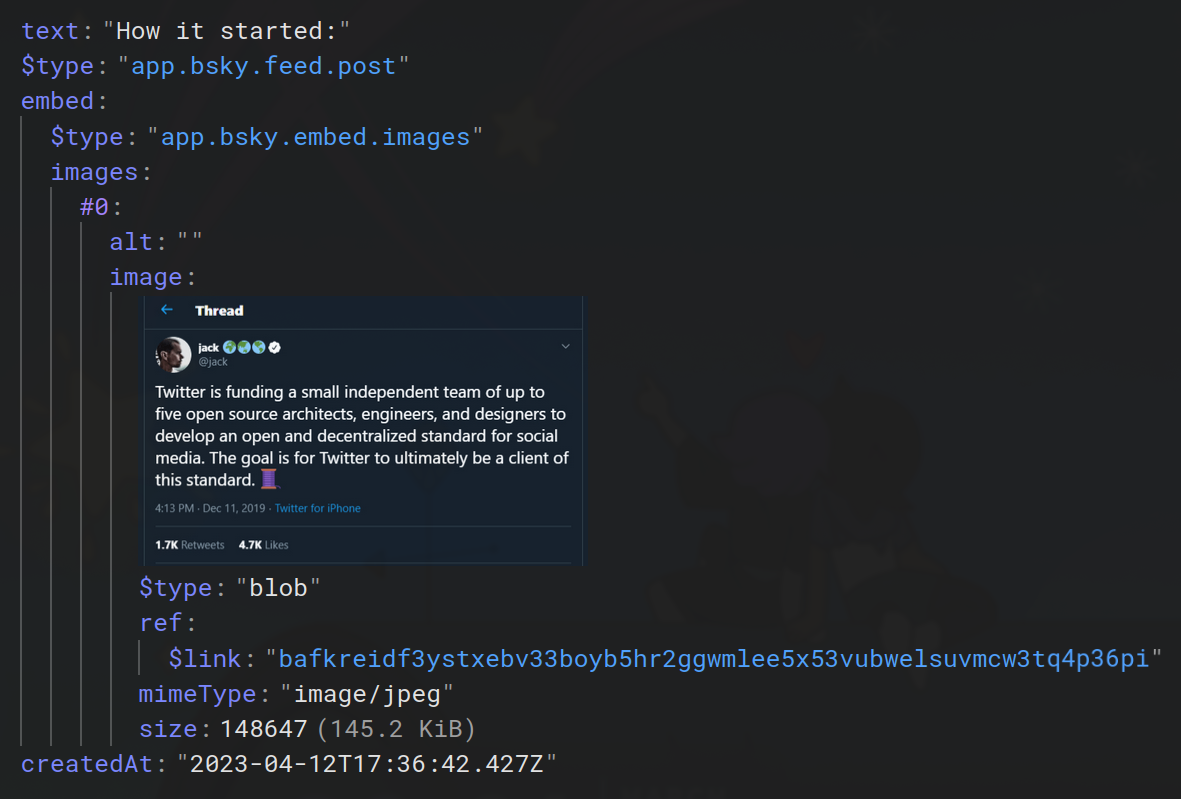
Records are stored in a Repo and grouped by Collections. Each record has a key that is unique within its collection.
Records must have a $type property equal to the collection it is inside in. For example, a record in the app.bsky.feed.post collection must have a $type property with the value app.bsky.feed.post.
Record Keys
Record keys can be any string, but they must be unique within their collection. They are used to identify and retrieve records from the repo.
By convention, record keys can be three types:
TID
The most common type of record key is a TID, which stands for "Timestamp ID". It's defined by the BlueSky team. A TID is a 64-bit integer encoded as a sortable base32 string. TIDs are generated by the client at the time of record creation, and they encode the timestamp of when the record was created. This allows for efficient sorting and retrieval of records based on their creation time. There's guaranteed to be no collisions with TIDs, as they are generated using a combination of the current timestamp and a random component.
Example TID: 3jzfcijpj2z2a
NSID
An NSID is "Namespaced Identifier". It's the same thing used for Collection names.
Literal
A literal key is any string that doesn't follow the TID or NSID format. Literal keys can be used for records that require a specific identifier that doesn't fit the TID or NSID patterns. For example, many "singletons" (collections that only have one record) use the literal key self.
Validating Records
Records can be validated against a Lexicon to ensure they conform to the expected structure and data types. When creating or updating a record, the Application can ask the PDS to validate the record against a specific lexicon. If the record does not conform to the lexicon, the PDS will reject the operation and return an error.